
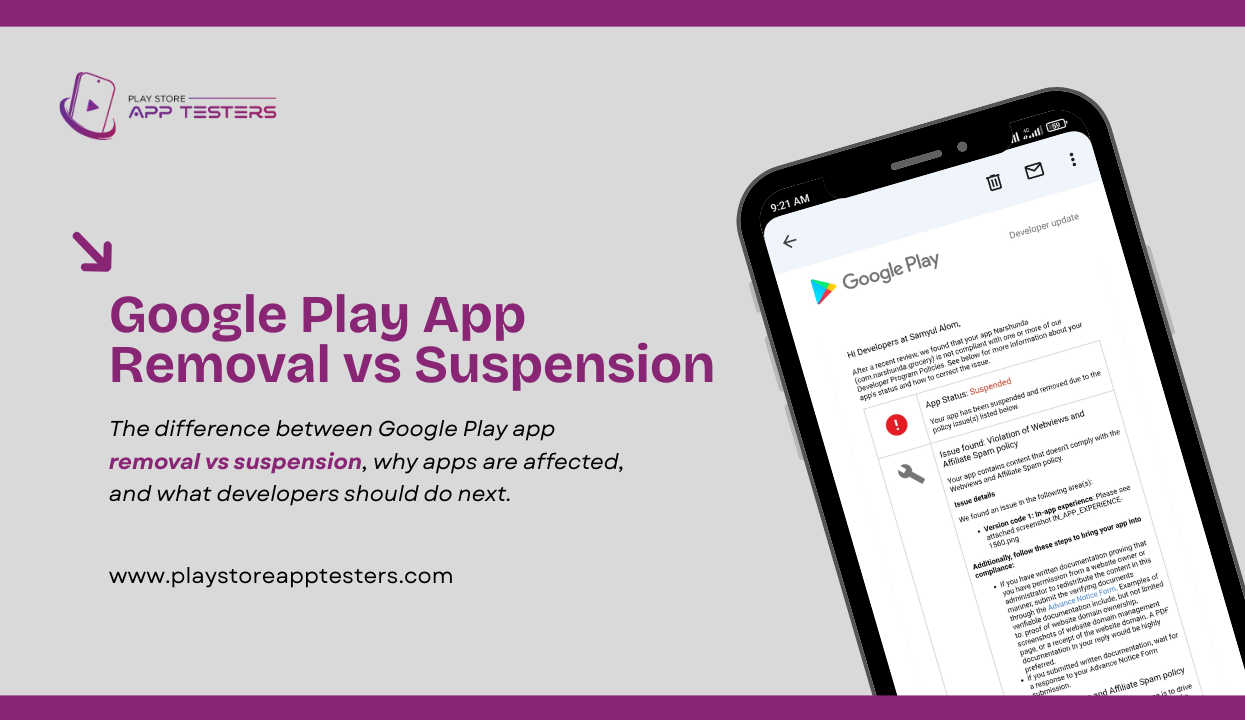
The accomplishment of getting an Android application into Google Play App Removal vs Suspension most developers get at a loss and even panic when Google acts against their application. The two most frequent ones are the removal of apps and the suspension of apps. Although the two can also have the same effect on your app visibility and performance, they differ.
It is important to know the distinction between removing apps on Google Play and being suspended to ensure that you protect your application, users, and developer account. We will properly define all the action taken in this guide, why it occurs and what the developers should do next, to prevent long-term harm.
How Google Play Enforces Its Policies
Google Play has a secure and reliable ecosystem due to the implementation of rigid developer policies. Enforcement is done through:
- Artificial intelligence-driven automated systems.
- Manual human reviews
- User reports and complaints
- Virtual follow-up monitoring.
Due to this reason, an application can be given a green light during its debut but subsequently taken against in case there is a discovery of a breach.
What Is Google Play App Removal?
App removal When your app is removed, it is removed off the Google Play Store listing. New users will not be able to find or download the app, but the developer account tends to be active.
Key Characteristics of App Removal
- The app is not open-source anymore.
- The app can still be installed by the existing users.
- The account of the developer is normally not suspended.
- Action is often reversible
The minor or repairable policy violations are usually removed.
Common Reasons for App Removal
Google Play can delete an application due to a number of reasons such as:
- Minor policy violations
- Lacking or wrong privacy policy.
- False advertisement of applications or images.
- Unreasonable or unneeded access rights.
- Problems with performance (e.g. crashing or ANRs).
Google gives a warning which precedes removal in most cases.
What Is Google Play App Suspension?
The more severe of the enforcement actions is the suspension of apps. In case an application is suspended, it will be taken out of the store, and Google regards it as a strong violation of the policy.
Major features of App Suspension.
- The app is automatically deleted out of the store.
- Under the same listing, the App cannot be republished.
- Offence against your developer account is registered.
- Suspensions may also be repeated and termination of accounts will occur.
Suspensions are a sign to show that Google has no confidence in the compliance of the app.
Usual Reasons for App Suspension
Serious or repeated violations, including, are typically suspended in Apps:
- Malware or harmful behavior
- False or fraudulent practice.
- The abuse of sensitive user data.
- Impersonation or violation of copyright.
- Violation of policies several times following warnings.
It is far more difficult to restore suspensions than removals.
Google Play App Removal vs Suspension: Key Differences
| Feature | App Removal | App Suspension |
| Severity | Moderate | High |
| Reversibility | Often reversible | Usually permanent |
| Developer Account Impact | Low risk | High risk |
| Republish Allowed | Yes (after fixes) | No (same app) |
| Policy Record | Minor | Major violation |
These differences can be explained to make developers react appropriately and prevent escalation.
What Happens to Users After Removal or Suspension?
The effects of action on an app by Google do not involve the developer alone. It also has a direct impact on the users and the experience is varied when it comes to removing the app or the suspension.
After App Removal
Once an app has been removed out of the Google Play Store, it cannot be downloaded anymore, but it is not entirely erased off the face of the earth.
What users experience after app removal:
- Existing users may continue using the app: Users who have already downloaded the app are usually allowed to continue using the same in their devices. But functionality can be compromised with time when the app is based on updating the server or APIs.
- The app no longer receives updates:The deleted applications cannot be updated in Google Play. This implies that the users are not receiving any bug fixes, security patches and new features that may ultimately render the app unstable or unsafe.
- New users cannot download the app: The application is removed in search and stores. Even new users are denied access to finding the app and downloading it.
- Potential compatibility issues over time: Android versions that uninstall apps may cause a crash or performance problems to users who had previously used them.
After App Suspension
Suspension of apps has greater immediate and stronger effects on users.
What users experience after app suspension:
- The app is removed for all users: The application is completely removed off the Play Store. Google can also limit its functionality in certain instances particularly when there is security or privacy risk presented by the app.
- Loss of trust in the app and developer: The user might lose trust in the app particularly when it had anything to do with security, misuse of data or dishonest dealing. This may ruin the reputation of the developer in the long run.
- Future updates and support are unavailable: Because the suspended applications can not be published again within the same listing, the user does not get any updates, corrections, and official support in the future.
- Harder approvals for future apps: This directly impacts developers, but impacts users too due to the likely tightening of reviews of future apps of the developer or delays, restricting innovation and updates.
Impact on User Trust and Experience
User trust is also impacted in both instances particularly when the app was used by many people. The abrupt loss, absence of support, or security risk may make users uninstall the application and prevent the usage of further products by the same developer.
In the case of apps that deal with sensitive data, the damage to trust may be long-term and hard to recover.
Can a Removed App Be Restored?
Yes, in most cases.
Steps to Restore a Removed App
- Go over the notice of policy violation.
- Identify the exact issue
- Fix all compliance problems
- Resubmit the app to be reviewed.
Apps are normally restored by Google provided that problems are addressed adequately.
Can a Suspended App Be Reinstated?
Suspension is hard to come out of, though.
Appeal Process
- Submit a detailed appeal
- Specify how the violation has taken place.
- Give evidence of compliance changes.
Slim or emotional appeals are usually ignored. Google does not want promises but obvious facts.
They should have been informed on how to prevent app removal or suspension.
It is much better to prevent rather than to cure.
How to Avoid App Removal or Suspension
Policies are used during development until after launch. Check them periodically, at least Follow Google Play Policies Carefully
Policies apply from development to post-launch updates. Review them regularly, especially after policy updates.
Test Before Every Release
Testing should include:
- Stability test (crashes and ANRs).
- Permission validation
- Security and data management audits.
Avoid Risky Third-Party SDKs
There are SDKs that break the policies unintentionally by the developers. Always make sure the SDK is compliant.
Why Real App Testing Matters
Real world conditions are frequently not taken into account in internal testing. The real users discover problems concerning:
- Device compatibility
- Performance under load
- Unforeseen permission behavior.
Play Store App Testers is a professional testing company that assists developers in the early recognition of risks, minimizing the rejection rates, and enhancing the overall quality of the app.
Impact on Your Developer Account
Long term account damage is one of the greatest threats of being suspended.
- Various suspensions may result in bans that are permanent.
- Submission of new apps might be stricter.
- Account score on trust declines.
It is imperative to have a clean compliance track record in order to succeed in the long-term.
Best Practices for Long-Term Compliance
- Check updates on Google Play console every day.
- Keep documentation updated
- Update apps regularly
- Act on policy promptly.
Such practices would greatly lower the chances of enforcement.
Conclusion
The distinction between the Google Play App Removal vs Suspension can help developers make expensive errors. The removal is typically a message of warning and a chance to correct the errors but suspension is a severe measure that may devastate your whole developer account.
The developers can reduce risks by adhering to Google Play policies, conducting extensive testing, and engaging in the use of real app testers to create trustworthy apps, which will be successful in the long run.
Being compliant is not a single exercise, but a continuous process.