
To succeed in the current competitive market of mobile applications, it is not sufficient to create an app. Quality, stability, security and compliance are the ingredients of success. At this juncture, Quality Assurance vs Quality Control are very essential.
Most developers confuse and use the terms QA and QC interchangeably, however, in practice they are used at different stages of the lifecycle of the app development. It is important to know the distinction between quality assurance and quality control in app testing- particularly among developers who intend to launch apps in Google Play store.
This article describes QA and QC in detail and emphasizes their differences, as well as demonstrates how these two measures help to improve the quality of the app and help it be accepted in the Play Store.
Understanding App Quality in Modern Development
Users of mobile devices demand applications to be:
- Fast and responsive
- Safe and privacy-enhancing.
- Free from crashes and bugs
- Easy to use across devices
Google Play has stringent rules to ensure the safety of users and the integrity of its ecosystem. Those apps that do not comply with these standards are usually rejected, suspended or removed.
Quality of apps is not something that can be done in one step. It requires:
- An excellent development process.
- Proper testing strategies
- Constant observation and enhancement.
This is precisely where Quality Assurance and Quality Control will be necessary.
What Is Quality Assurance (QA)?
Quality Assurance is a process oriented strategy that strives to avoid occurrence of defects. QA begins in the planning phase and goes through to the entire life cycle of app development.
QA is not concerned with bugs being found after the creation, but rather is aimed at creating a system and a workflow that reduces all possibilities of errors.
Quality Assurance in Simple Terms
QA means:
Designing the app in the correct manner.
Key Objectives of Quality Assurance
- Avoid causes of defects and do not rectify them afterwards.
- Make sure that development standards are taken into account.
- Be consistent and reliable.
- Cut down on the long-run expenses and rework.
QA Activities in App Testing
Quality assurance entails a number of structured activities namely:
Requirement Analysis
Requirement analysis is a process that entails a clear definition of the features, functionality and user flow of the app. At this point, the requirements are checked to ensure that such requirements are realistic and in accordance with Google Play Developer Policies. Clear requirements assist in avoiding errors of the development process, redundant work, and the policy breaches early in the process.
Test Planning and Strategy
Test planning is concerned with the development of a total roadmap towards app testing. It determines the nature of testing that is necessary like functional testing, security testing, performance testing and usability testing. An effective testing plan makes the testing process systematic and that they are mindful of critical problems that should not be ignored.
Process Documentation
The documentation of the process lays down explicit instructions on the devising, testing, and deployment process. It consists of coding conventions, testing processes, bug reporting, and release processes. Good documentation enhances better coordination of the team and also assists in ensuring a consistent quality of the app in subsequent releases.
Compliance Review
Review of compliance checks on app permissions, data collection and privacy. This would be done to make sure that the application only requests the permissions required of it and processes user data safely and transparently. Before long, compliance checks will minimize the chances of rejection or suspension of Google Play apps.
Continuous Improvement
Continuous improvement concentrates on learning, and making mistakes and feedback. Through the study of bugs in the past, Play Store rejection, and user feedback, the product development and testing can be optimized. The method will assist in providing long-term app quality, stability, and compliance.
What Is Quality Control (QC)?
Quality Control is a product oriented-based strategy, whereby the actual app is tested to detect defects. QC occurs when the app is already developed, and has a working version.
QC deals with the end output as opposed to QA which deals with the process.
Quality Control in Simple Terms
QC means:
Evaluation of the completed app in order to detect and correct errors.
Key Objectives of Quality Control
- Identify defects and technical problems.
- Test application performance and stability.
- Make the app work as expected.
- Enhance user experience prior to launch.
QC Activities in App Testing
The quality control usually entails:
- Manual Testing: Using the app as a real user to find out its usability and functional problems.
- Automated Testing: Conducting test scripts to verify the repeated performance of apps after updates.
- Crash and ANR Testing: Having no freezing, crashing, and unresponsiveness of the app.
- Permission Testing: Ensuring that the necessary permissions are requested and used appropriately.
- Bug Reporting and Verification: Documenting issues clearly and confirming fixes before release.
QC has direct influence on the user satisfaction, application ratings, and reviews of the stores.
Quality Assurance vs Quality Control: Key Differences
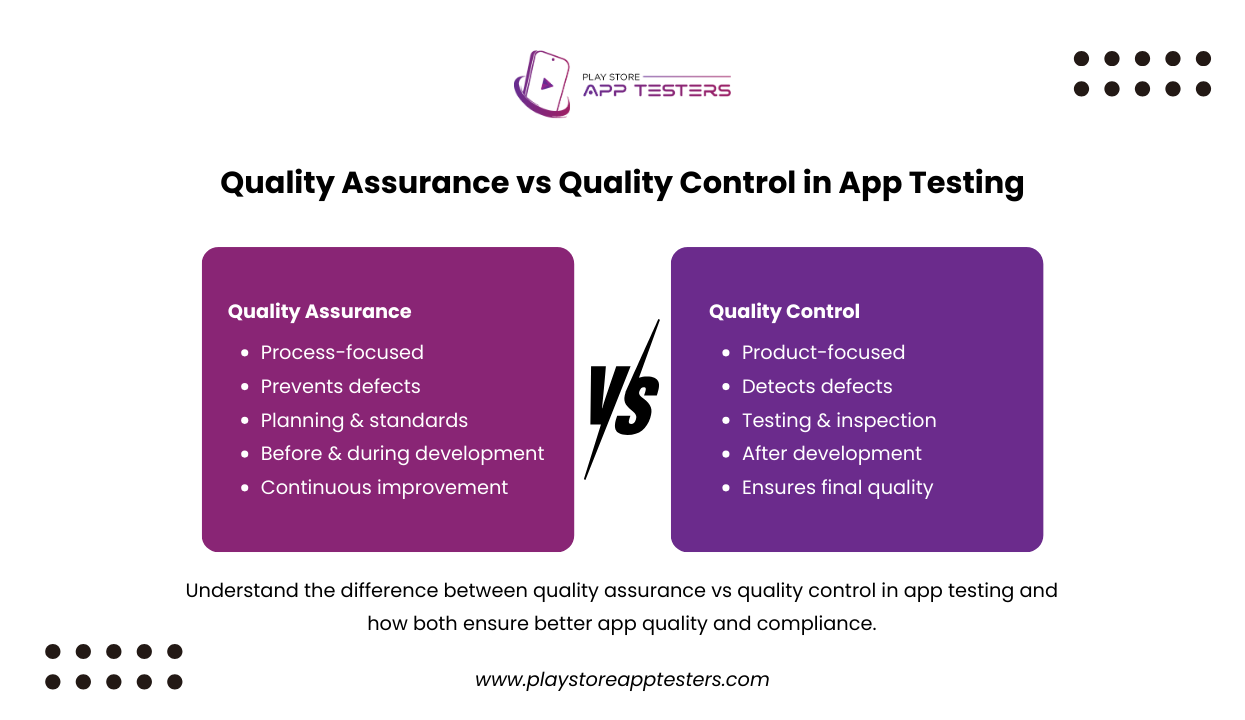
Granted that Quality Assurance vs Quality Control are aimed at the same outcome, namely high app quality, they do it differently.
Core Differences Explained
Quality Assurance (QA)
- Process-oriented
- Concerns itself with defect prevention.
- Starts before development
- Enhances working processes and quality.
Quality Control (QC)
- Product-oriented
- Focuses on defect detection
- Occurs after development
- Tests the final app
Simple Comparison
- QA = Prevention
- QC = Detection
One cannot substitute the other and the other is indispensable.
Role of QA and QC in the App Testing Lifecycle
Quality Assurance vs Quality Control collaborate during the lifecycle of the app development.
Planning Stage
- QA examines demands and policies.
- The areas of risk are discovered at an early stage.
Development Stage
- QA makes sure that there is adherence to code standards.
- QC can carry out unit or preliminary testing.
Testing Stage
- QC performs functional, performance and security testing.
- Bugs are reported and fixed
Pre-Submission Stage
- Play Store compliance is checked through QA.
- QC verifies the final build
Any one of the steps omitted will expose a great deal of risk to be rejected or suspended by the Play Store.
Why Quality Assurance vs Quality Control Matters for Google Play Compliance
The three areas that Google Play pays much attention to are user safety, data privacy, and app reliability. It does not accept apps that work, but those that are of high quality and policy. Quality Assurance and Quality Control will assist in making sure an app is in line with Google Play standards and will not be rejected or suspended.
Google Play Requires Apps to Be Stable and Secure
Google Play anticipates apps that will not crash and freeze on a regular basis. App removal can occur due to security weaknesses, shaky releases or insecure SDK usage. QA implements secure development and QC determines the stability problems in the form of real testing prior to submission.
Google Play Requires Transparency About Data Usage
These apps should show clearly, what user data is being gathered, how the information will be used and why it is necessary. QA is a way of keeping privacy rules in mind during the development process, and QC is an assurance that the privacy policy and permissions that the app claims is actually the case.
Google Play Requires Apps to Be Free from Misleading Behavior
Google Play policies are violated by misleading content, functionality, or deceptive advertisements. QA assists in creating honest app flows that are consistent with policy guidelines, and QC ensures by doing testing that there is no misleading behavior in the completed app version.
How QA Supports Play Store Approval
Quality Assurance is a proactive approach where it tries to avoid the compliance issue before it gets to the Play Store review level.
Prevents Policy Violations Early
QA considers Google Play policies during the planning phase and implements them in the requirements of the apps. This initial congruence can eliminate the frequent instances of policies being violated and thus the rejection or blockage of apps after they are submitted.
Ensures Privacy and Permission Compliance
QA also makes sure that the unnecessary permissions are not requested and sensitive data is utilized in a responsible way. Following the principles of privacy-by-design, QA minimizes the threat of permission abuse which is one of the most frequent causes of Play Store rejection.
Reduces Rejection Risk
A good QA practice will lead to a well-designed, compliant and predictable application. This will greatly enhance the possibility of overcoming the automated and manual review of Google Play without failure.
How QC Supports Play Store Approval
Quality Control also makes sure that the finished app build is of quality by doing hands-on testing.
Identifies Crashes and Performance Issues
QC validates the app on various devices, Android levels and usage conditions. This is useful in revealing crashes, ANRs, slow response times, and memory problems that may get Play Store ventured.
Improves App Stability
QC enhances the stability of the apps in the long run through test and verification. A stable application has higher chances of being accepted and accepted by Google Play reviewers and end users.
Reduces Negative User Feedback
QC detects functionality and usability problems early before launch and odds of low ratings and unfavorable reviews are minimized. Good user feedback will enhance credibility of the app as well as enhance long term performance on the Play Store.
This is the reason as to why, professional Android app testing services invariably integrate together both QA and QC.
QA vs QC in Professional App Testing Services
App testing providers are professional which does not depend on a single approach. They combine QA and QC in order to provide quality results.
Quality Assurance Services Typically Include:
- Policies and compliance audits.
- Test strategy development
- Suggestions on process improvement.
- Risk and security testing.
Quality Control Services Typically Include:
- Manual app testing
- Automated testing
- System and hardware compatibility testing.
- Security testing and performance testing.
Engaging real app testers will also enhance better coverage of the tests by detecting real-world problems that internally-based teams fail to detect.
Common Mistakes Developers Make with QA and QC
Some of the common pitfalls that result in the failure of apps include:
- Confusion of QA and QC.
- Use of QC at the end stage.
- Unregarded Google Play policy checks.
- Submission of rushed testing.
Such errors invariably result in rejection of apps, suspensions or negative user reviews.
Best Practices to Balance QA and QC
In order to have homogeneous quality of apps, developers ought to:
- Begin QA in the planning stage.
- Use real devices and users to perform QC.
- Blend the manual and automated testing.
- Keep a watch on Google Play policy changes.
This mediocre approach leads to:
- Higher approval rates
- Better app performance
- Long-term maintainability
Quality Assurance vs Quality Control: Which Is More Important?
The answer to this question is easy:
- Both are equally important.
- QC is proactive and expensive without QA.
- QA does not have any true validation without QC.
Effective apps are based on an effective QA process with effective QC testing.
Conclusion
Knowing the difference between quality assurance and quality control in the app testing is crucial to the developers interested in the long-term success of the Google Play Store.
QA is important in that it guarantees that the app is appropriately constructed at the start, whereas QC is important to guarantee that the final product satisfies the quality requirements. They combined contribute to the prevention of policy violations, bugs reduction, better user experience, and enhanced chances of approval.
If you are not joking about rolling out and supporting a successful Android application, professional QA and QC practices are not a luxury, but rather a necessity.
Quality testing does not merely correct defects. It instills confidence, credibility and success.